May 16 -30, 2011

Rebuilding Civil Society in Buenos Aires:

Historic Preservation, Labor, and Movements for Social Justice

Thursday, May 19, 2011

Madres, and tango


After lunch we had a little free time to shop and look around the "microcentro" business district. Max took some students to Puerto Madero to see the Calatrava bridge (Puente de la Mujer) and the new buildings near the river. Meanwhile, we went to eat ice cream, which made certain children very happy (above).

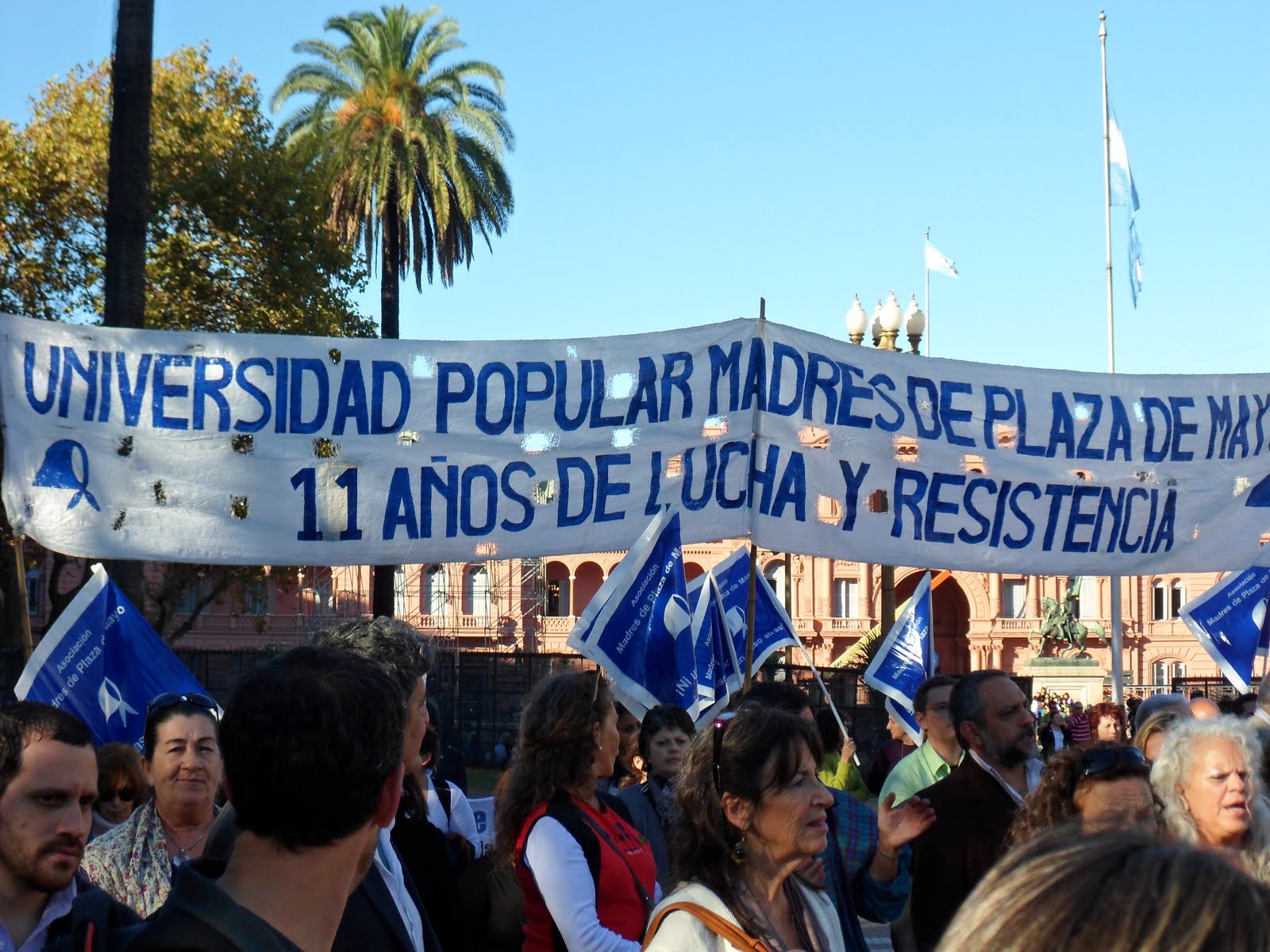
At 3:30 we all met in the center of the Plaza de Mayo, to see the Madres march. For 34 years, they have been marching at 3:30 every single Thursday. They march in memory of their "disappeared" and murdered children, and to demand justice. They Madres are joined by younger people who support their calls for social justice and human rights around the world. After the march, we stayed for their rally and speeches. Sergio was nice enough to come meet us at the Plaza and he gave a group of us an architectural tour of the neighborhood.

Then we walked to La Confiteria Ideal, which is a very elegant old 1940s restaurant with a dance hall upstairs. We had drinks and watched people dance tango. At this place, they dance tango every afternoon and evening, often with live orchestras. They also have tango classes and performances, but all open to anyone who wants to dance. Many of our students were asked to dance, but declined -- none of the women were wearing the requisite super-high-heeled tango shoes. Some of the couples were superb dancers and others were just there to have fun. We plan to see more tango later in the week.

A labor center in Buenos Aires


This morning we took the subway downtown to the Taller de Estudios Laborales (TEL) -- which means labor studies center or labor studies workshop. There we met with the director, Daniel Ximenez, who told us all about their work. TEL is an independent center that works closely with union activists from many sectors: metal workers, telecommunications, teachers, food service, transportation, professionals, brewery workers, subway drivers, and more. They use popular education model to help workers to come up with new solutions to the problems they face in the workplace. They call it "building new knowledge" with union activists, because the problems they are facing now are different than anything that has happened in the past, and they need new approaches. Daniel compared TEL to Labor Notes, because of its focus on democratic grassroots leadership. But TEL does not have a regular publication and Daniel stressed that TEL does not take sides in internal union disputes -- they work with any group of workers who want to take a leadership role and improve their workplace or their union.

Daniel talked about the changes in the labor movement in Argentina over the past two decades. In 2001, after the economic collapse, workers were very afraid to participate in workplace actions or unions. Unemployment levels were above 25 percent and workers who had jobs could not risk losing them. Only once the economy improved did the labor movement start to gain strength again. Daniel was optimistic about the labor movement -- he said that in the last six years there has been a real recovery and workers are mobilizing. Two weeks ago, on Labor Day (May 1), over 300,000 workers demonstrated in the streets of Buenos Aires. The metal workers union grew from 70,000 workers in 2002 to 250,000 workers today. Daniel argued that the Argentine experience shows that when the economic situation is at its worst, people are not likely to protest. "People mobilize when they think they can achieve something better -- not because things are bad."

After a while, he was joined by a woman named Marianela, from an organization called FOL (Frente de Organizaciones en Lucha). They organize unemployed workers and "precarious" workers -- they estimate that 40 percent of workers are in positions that are not covered by the law, or part-time, or temporary, or otherwise marginal. Marianela talked about how her group has done many different things to mobilize these workers and improve their situations. The workers have created their own cooperative businesses (bakeries, carpentry, brick-making, building) to meet the needs of the workers themselves. They have protested and won changes in the law, so that even workers not covered by labor law are able to receive a subsidized salary from the state. They have done all kinds of direct action and creative protests to push the legislature to do the right thing, and they have been quite successful. We were all impressed with her work and her energy, and we made plans to go visit her organization later on.

Finally, just as we were getting ready to leave for lunch, a leader of the new union of subway drivers came by. Joaquin, who was wearing a Labor Notes "Troublemakers" sweatshirt, came to lunch with us and talked about his work. He also invited us to come to their office to participate in one of their regular "political discussions," as well as to a meeting that is happening tomorrow afternoon. Our schedule is already so busy, but everyone was excited about the work of TEL and FOL and we're trying to figure out a way to have more time to meet with workers, both the unemployed and union activists.


Club for dinner


On Wednesday evening, the students again met with their Espanol 4D teachers and spent 3 hours walking around Palermo, learning to buy groceries and get directions and speak a little more Spanish. Then we all met for dinner at a typical "club barrio" (neighborhood club) of Palermo. It's a place with a gym (kids were playing a serious game of futbol while we ate), community rooms, and a popular cafe. They set up tables for us in the lobby and served dinner. Lots and lots of meat was consumed.

Here's a photo of our three fabulous Spanish professors: Tatiana, Pancho, and Leti, with Sarah on the left and Sameerah on the right (the first time Sameerah has been on the right, ha ha).

Wednesday, May 18, 2011

ESMA


We thought that a 10:00 start this morning would give us plenty of time to wake and have a leisurely breakfast...but some of us bolted awake at 9:30 a.m. and had to rush to get ready. The hotel breakfast was surprisingly hearty. Most Argentina breakfasts consist of a pastry and a cup of coffee, but the hotel also had scrambled eggs, sausage, yogurt, cereals, many kinds of fruit, croissants and pastries. After we gulped it down, we went to the bus stop and waited quite a while for Bus 15 to come -- when it finally came, there were three in a row and they were all full. All 18 of us squeezed on anyway and used a whole roll of coins to pay the 1.20 per person (about 30 cents US).

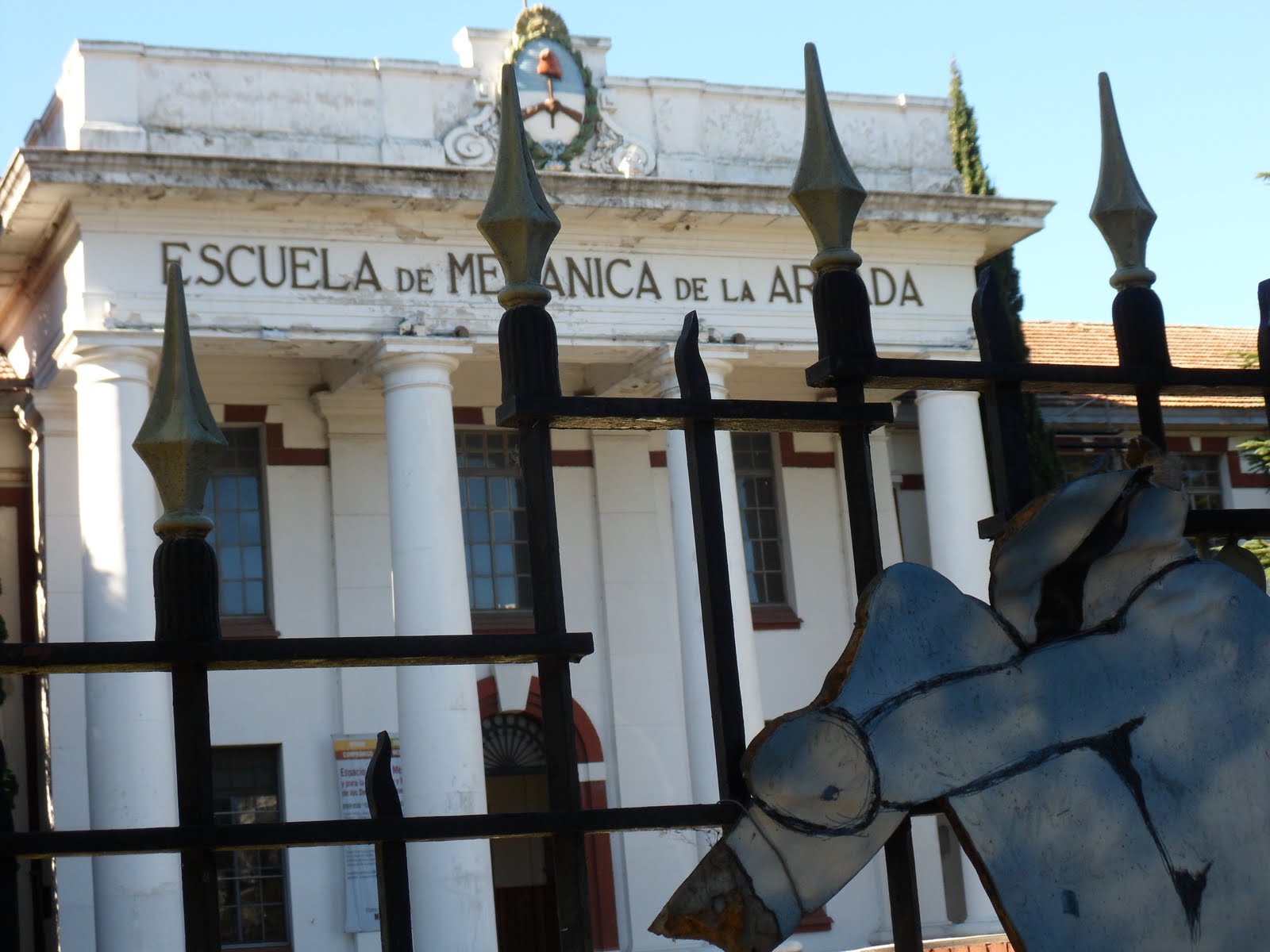
Our main visit today was to the ESMA - Escuela Mecanica de la Armada - a naval training station and one of the most infamous clandestine detention centers of the dictatorship. From 1976 to 1983, more than 30,000 people in Argentina were "disappeared" -- kidnapped from their homes or workplaces or trains or the street, and brought to detention centers where they were systematically interrogated, tortured, and murdered. Over 5,000 of these political prisoners were brought to ESMA, which was operated by the Navy. About 200 of those people survived, while the rest were killed on "death flights" that ended with their drugged bodies being dumped into the ocean. The survivors have provided a rich picture of life at ESMA and the agenda of the dictatorship.

We had an excellent guide, Pablo, a graduate student in Philosophy who has worked at ESMA since it opened to the public in 2007. We spent three hours with him, seeing the clandestine detention center and learning a lot about the ideology and planning behind the disappearance and deaths of so many Argentine activists. He talked a lot about the economic and political motivation for the dirty war, and the role of international organizations, including the School of the Americas in the US and the French military, in training Latin American military leaders in the techniques of "modern war." They planned Operation Condor, which was a coordinated set of military operations in many South American countries, as a way of eliminating what they called "the internal enemy" -- starting with union activists (who were loyal to Peronism and quite powerful in that era), leftist intellectuals, student activists, and anyone who challenged the authority of the government and the neoliberal agenda.

The legacy of the dictatorship is still being determined in Argentina. The government is now supporting investigations into the "state terrorism," and the public is divided about how much people should be made to pay for events of the past. ESMA itself is a contested site. Unlike many museums that commemorate genocide and violence, there are no dramatic photos or mementos of the disappeared. The main building is empty, save some posters with explanations of how the rooms were laid out when it was used for torture and imprisonment. One reason is that the building itself contains evidence that is being used in trials that are happening now, of some of the repressors responsible for the violence. Within ESMA's compound, about 30 smaller buildings have been given to activist organizations including the Madres de la Plaza de Mayo, the Abuelas (grandmothers) de la Plaza de Mayo, and the Hijos (children) de la Plaza de Mayo. Some of them use the space for centers of memory, some for ongoing research into the disappearances, and some for community centers looking toward the future rather than the past. We will come back to these debates again and again during the next two weeks.

Tuesday, May 17, 2011

Sergio and Laura's house


After the students spent 3 hours working on some Spanish and touring Recoleta (the highlight was the cemetery where Evita is buried), we met at the lovely apartment of Laura and Sergio Kiernan. They have a gorgeous "post-war" apartment that they bought 8 years ago and completely renovated. They and their three children were very kind and hospitable and they fed us a very delicious dinner of empanadas -- the typical chicken and meat ones, but also corn, artichoke, cauliflower, potato and onion, cheese and tomato -- more vegetarian empanadas than we had ever seen, and all spectacular. Sergio is a journalist with the important newspaper "Pagina 12" and he talked for a while about Argentina's history and Buenos Aires politics. The students are completely exhausted but they had lots of good questions and engaged in an interesting discussion with Sergio.

After dinner, ice cream, coffee, and conversation, we walked a while and then took the subway back to the hotel. It's late and we have another busy day tomorrow...

Lunch


We had a little time to explore our neighborhood in Palermo. It has gotten a bit "gentrified" since we were last here in January 2010, and people say that restaurants and apartments are much more expensive. We had a very good lunch of fresh pasta and pizza and other things, around the corner at a new restaurant that we remember from when it was called "SuperPizza." Now it's called Tarantino's and it's full of movie posters.

Now the students have gone off with our friend Tatiana, who is a professor with her organization called Espanol 4D (www.espanol4d.com). She and two colleagues are taking groups of students on tours of the Recoleta neighborhood and teaching them some Buenos Aires "Porteno" Spanish. Everyone is in great spirits and surprisingly awake after all the traveling.

We've arrived!


We are in Buenos Aires! And what a relief -- the trip was much too long and exhausting. We are very happy to finally be here and getting settled.

A group of us met in Amherst at 1:45 p.m. on Monday, and boarded the Megabus at the Hampshire Mall: Sameerah, Kimal, Sybil, Mariah, Michele, Eve, Max, Jonah, Aviva, and Ruthie. The nice Megabus driver waited patiently for Max, who had to rush home to retrieve one important bag -- and we were on our way. The trip was easy until we got to Westchester County, and then we started sitting in traffic. From there to New York City it was slow going, and the bus was about 30 minutes late. We hopped off the bus at 28th and 7th Avenue, and tossed our heavy luggage in a van to head for JFK airport. And then we sat in heavy traffic once more. The trip from Amherst to JFK took us over six hours! We had planned to arrive at JFK by 7:00 p.m., but got there after 8:00 p.m. -- fortunately, we had plenty of time to check in and get a snack before boarding.

In New York, we met three more students -- Steven, Elizabeth, and Jennifer -- and our whole group sat nearby on the flight. It was looooooong -- some people slept and others read or watched movies. We arrived at Ezeiza Airport right on time, at 9:45 a.m. local time (it's one hour later here than in New York). At the airport we boarded another van, and sat in yet another traffic jam. This time, a cement truck had overturned and spilled wet cement all over the entrance to the highway, and some cars got stuck in cement. The accident had happened 5 hours before we arrived and it was still a huge mess. But we got past it, and after the driver took us in the wrong direction for a while, we set him right and arrived at our hotel just before 1:00 p.m. -- just 24 hours after leaving Amherst!

The hotel is not fancy, but it's clean and the rooms have nice views (we're all on the higher floors). The rooms all have little kitchens, stoves and refrigerators, and dining tables. Right now, Max has taken a group of students to find the essentials: the bank, the supermarket, the electrical adapters/converters, and subway tickets for later. The weather is perfect -- 68 degrees F, sunny and breezy -- much better than the cold rain we left at home! We are excited to be here and we will post more later. Meanwhile, here are some photos from our travels.


Friday, May 6, 2011

Getting ready for our trip


With only a few days to go, we are busy with last-minute trip preparations. Here is some information you can share with your friends and family:

1. We will arrive in Buenos Aires on Tuesday morning, May 17, 2011. Assuming no travel delays, we should arrive at the hotel by 1:00 p.m. If there are normal delays, it could be later in the afternoon.

2. The time in Buenos Aires is one hour *later* than U.S. Eastern time. When it is 9:00 in New York, it is 10:00 in Buenos Aires.

3. We have a very, very busy schedule and a full itinerary. Most days, we will leave the hotel right after breakfast in the morning and return after dinner in the evening -- and restaurants don't even open for dinner until 9:00 p.m., so it will be late.

4. We won't have access to phones that can call or text the U.S. (The hotel does have wireless internet, but it doesn't always work.) No one should be expecting to hear from you every day, and no one should worry if they don't hear anything for a while. We'll be fine!

5. In case of any emergency, the International Programs Office at UMass will be our liaison. We will let them know if anything comes up, and they will contact your family/friends immediately. If your family/friends need to reach you, they should first send an email to either of the faculty members. If they don't hear back, they can call Beth Berry at 413-545-4875, or the IPO at 413-545-2710 (24 hours, 7 days a week).

6. If you have any questions or concerns, please email the faculty at any time: Eve can be reached at weinbaum@lrrc.umass.edu and Max is at mpage@art.umass.edu.